
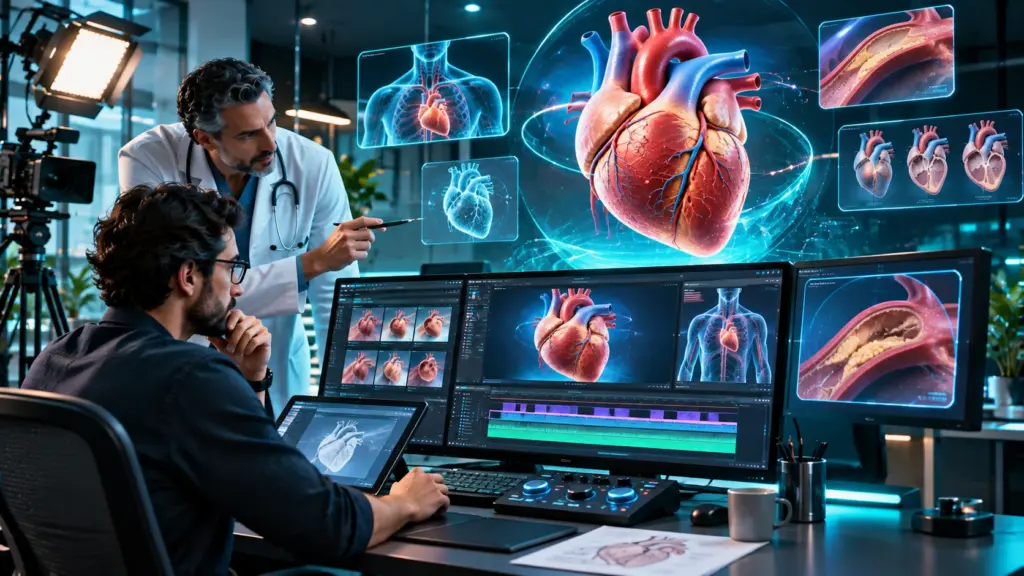
Healthcare organisations need clear, reliable communication to educate patients and explain complex medical services. However, traditional video production can make content updates and multilingual communication challenging. AI video production for healthcare offers a flexible way to create professional medical videos while maintaining clinical accuracy and patient trust.
What Is AI Video Production for Healthcare?
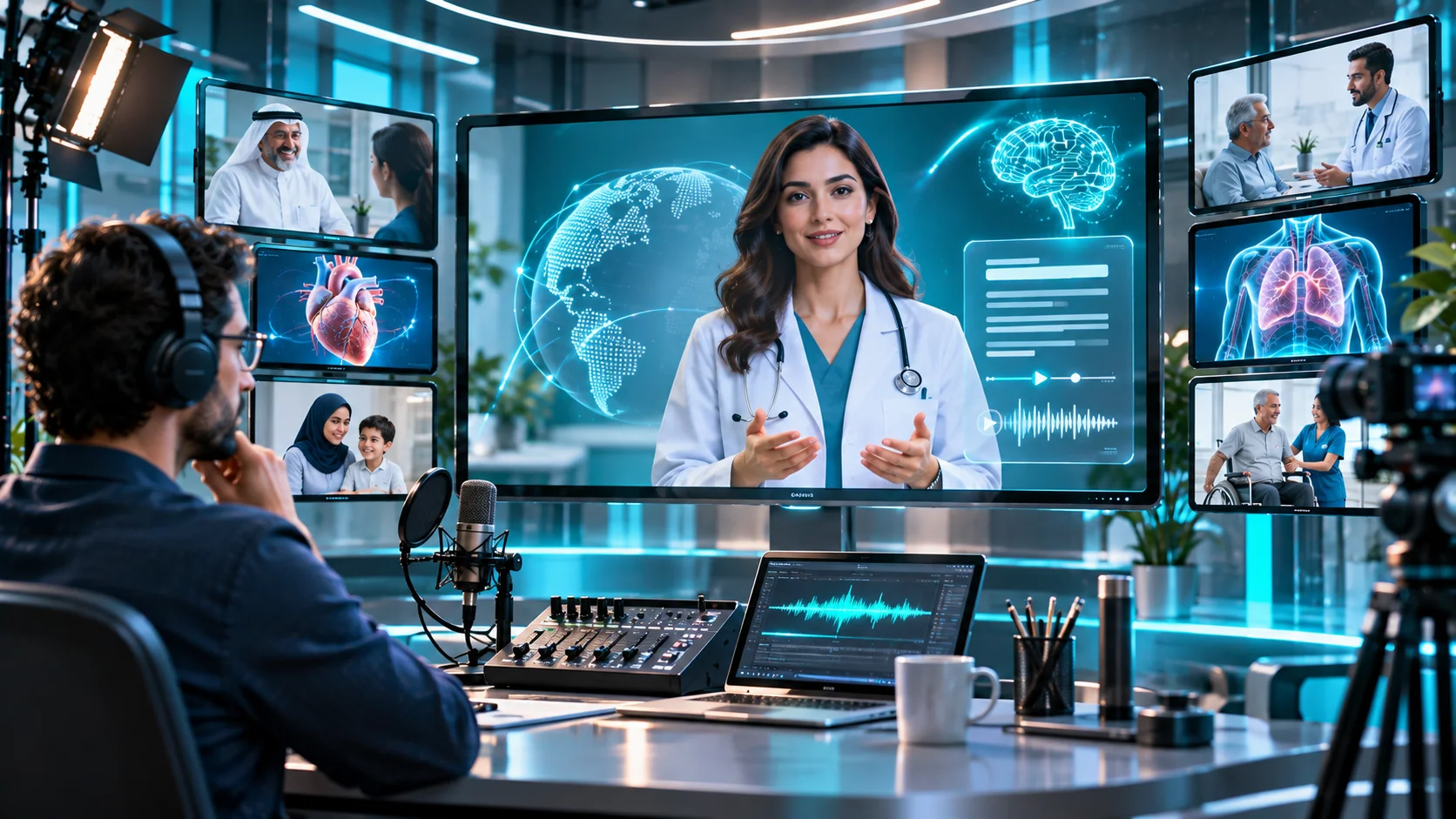
AI video production for healthcare uses artificial intelligence, generative technologies, and professional video editing to create educational, promotional, and training content for medical organisations.
It combines AI-generated visuals, digital presenters, animation, voiceovers, and traditional filmmaking techniques to communicate healthcare information in an accessible format.
Unlike general commercial video production, healthcare video creation requires additional attention to medical accuracy, patient privacy, clinical approval, and responsible communication.
Common applications include:
- Patient education videos: Explaining medical conditions, treatment options, procedures, and preventive healthcare practices.
- Medical explainer videos: Simplifying complex clinical concepts through animation, diagrams, and visual storytelling.
- Clinic introduction videos: Presenting healthcare facilities, medical professionals, departments, and available services.
- AI avatar presentations: Using digital presenters to deliver approved medical information and educational content.
- Healthcare training videos: Supporting staff education, internal procedures, and standard operating procedures (SOPs).
- Pharmaceutical communication: Developing educational and informational content for appropriate professional and public audiences.
- Multilingual medical videos: Adapting approved scripts into different languages to serve diverse patient communities.
The primary objective is to make medical communication more accessible without compromising the accuracy, clarity, and credibility expected from healthcare professionals.
How Does AI Video Production Help Healthcare Providers Educate Patients?
AI medical video production helps healthcare providers transform complex medical information into structured, accessible visual explanations that patients can review at their convenience.
Patients often need to understand unfamiliar medical terminology, diagnostic procedures, treatment pathways, and follow-up instructions.
Written documents remain important, but video can provide another way to communicate information through narration, animation, demonstrations, and visual examples.
For example, a clinic specialising in cardiovascular care could create an educational video explaining:
- What a particular cardiovascular condition involves.
- Why a diagnostic examination may be recommended.
- How patients should prepare for an appointment.
- What happens during a medical procedure.
- Which follow-up instructions patients should discuss with their healthcare provider.
Similarly, a dental practice could use animated explainer videos to demonstrate oral hygiene practices, describe common dental procedures, and introduce available treatment options.
Other practical applications include:
- Pre-appointment education: Videos can explain appointment preparation, required documents, consultation processes, and general instructions.
- Procedure explanations: Animated medical illustrations can help patients understand how a procedure works without relying exclusively on technical terminology.
- Post-treatment guidance: Healthcare organisations can create general educational videos covering recovery expectations, follow-up appointments, and instructions approved by the responsible clinical team.
- Preventive healthcare communication: Short videos can explain screening recommendations, healthy practices, vaccination information, and general health awareness.
These videos should complement, rather than replace, individual medical consultations and personalised clinical advice.
What Types of Healthcare Videos Can AI Create?
AI-supported healthcare video production can serve several communication needs, from patient education and clinical training to institutional marketing and professional presentations.
The appropriate format depends on the audience, subject complexity, and communication objective.
1. Medical explainer videos
Medical explainer videos use animation, diagrams, and narration to make clinical subjects easier to understand.
For example, a video could illustrate how blood circulates through the heart or explain the basic stages of a diagnostic examination.
2. Patient education videos
These videos provide accessible information about medical conditions, preventive care, treatment pathways, and general healthcare practices.
They can be organised into educational series covering frequently asked patient questions.
3. AI avatar-led medical videos
Digital presenters can deliver approved scripts in a consistent presentation style.
They may be useful for appointment instructions, general health awareness, and introductory information about medical services.
However, synthetic presenters should not be presented as real doctors or qualified medical professionals when they are not.
4. Healthcare marketing videos
Clinics and medical organisations can use professional videos to introduce their facilities, explain available services, and communicate their approach to patient care.
Marketing content should remain factual, appropriately qualified, and consistent with applicable healthcare advertising regulations.
5. Medical staff training videos
Healthcare organisations can develop educational materials covering internal workflows, administrative procedures, equipment orientation, and standard operating procedures.
6. Pharmaceutical and medical technology videos
Pharmaceutical organisations and healthcare technology companies can use animation and CGI to explain product functionality, medical technologies, and approved educational information.
Content involving medicines and medical devices requires additional regulatory and scientific review.
7. Multilingual healthcare videos
AI-assisted translation and voice generation can support the adaptation of approved educational content into multiple languages.
Professional linguistic and clinical reviews remain necessary to ensure that translated medical information preserves its original meaning.
How Does AI Improve Multilingual Medical Video Production?
AI-assisted production can simplify the adaptation of healthcare videos into multiple languages while maintaining a consistent communication structure.
Language accessibility is an important consideration for clinics, hospitals, and healthcare organisations serving culturally and linguistically diverse communities.
A medical video originally produced in English, for example, could be adapted into Arabic, French, Spanish, or other languages according to the intended audience.
The process may include:
- Translating the approved medical script.
- Reviewing medical terminology in the target language.
- Generating or recording a suitable voiceover.
- Synchronising narration with the visual presentation.
- Adding translated subtitles and captions.
- Reviewing pronunciation and cultural suitability.
- Obtaining clinical approval before publication.
AI-generated voices and avatars can support this workflow, but automated translation should never be treated as a substitute for qualified medical and linguistic review.
Quick Facts
- AI video production can support patient education, clinical communication, and healthcare marketing.
- Medical explainer videos help communicate complex subjects through animation and visual storytelling.
- AI avatars can present approved educational scripts.
- Multilingual workflows can support communication with diverse patient communities.
- Clinical review is essential before publishing medical information.
- Healthcare video workflows should protect patient privacy and confidential information.
- Captions and accessible visual design help make medical content easier to understand.
- AI-generated content should complement professional medical advice, not replace it.
Is AI Video Production Safe and Suitable for Healthcare Organisations?
AI medical video production can be suitable for healthcare organisations when privacy, information security, medical accuracy, and clinical oversight are built into the production process.
Healthcare content is different from ordinary commercial content because mistakes can affect how people understand medical conditions, procedures, and treatment options.
A responsible production workflow should address several important considerations.
1. Clinical accuracy
Every medical script should be reviewed by an appropriately qualified healthcare professional before production or publication.
The review should cover:
- Medical terminology and definitions.
- Treatment descriptions.
- Procedure explanations.
- Clinical recommendations.
- Potential risks and limitations.
- References to approved clinical guidance.
AI-generated scripts should never be treated as authoritative medical information without verification.
2. Patient privacy and HIPAA considerations
Healthcare organisations operating in the United States must consider applicable HIPAA privacy and security requirements when handling protected health information.
A video production workflow should avoid exposing patient records, identifying details, consultation recordings, or other sensitive information to unauthorised systems.
Organisations should assess the security practices of any technology provider involved in handling electronic protected health information.
Where applicable, business associate agreements and appropriate administrative, physical, and technical safeguards must be considered.
Importantly, describing a workflow as HIPAA-conscious does not automatically make it HIPAA compliant. Compliance depends on the actual data processing arrangements, responsibilities, safeguards, and applicable legal requirements.
3. Responsible use of AI avatars
Digital presenters should be used transparently.
Healthcare organisations should avoid creating synthetic medical professionals that could mislead patients about a presenter’s identity, credentials, or involvement in clinical care.
4. Medical advertising and regulatory requirements
Healthcare promotional videos should communicate services and treatment information accurately.
Content relating to pharmaceutical products and medical devices may be subject to additional regulatory requirements, depending on the jurisdiction and intended audience.
5. Accessibility and clear communication
Medical videos should use understandable language, readable graphics, suitable contrast, and accurate captions.
The goal is to make healthcare information accessible to different audiences without oversimplifying clinically important details.
AI Video Production vs Traditional Healthcare Video Production: What Is the Difference?
AI-assisted and traditional video production can both support healthcare communication, but they differ in how content is developed, presented, and updated.
| Comparison | AI-Assisted Healthcare Video | Traditional Healthcare Video |
| Content creation | Uses generative tools, animation, and digital assets | Uses conventional filming and production |
| Presenters | Can include AI-generated avatars | Uses real medical professionals or actors |
| Medical animation | Supports digitally generated visual explanations | Uses conventional animation and CGI workflows |
| Multilingual adaptation | Can support automated translation and voice generation | Often requires separate recording sessions |
| Content updates | Selected scenes and presentations may be easier to revise | Changes may require additional filming |
| Production flexibility | Supports different visual styles and formats | Depends on filming locations and production arrangements |
| Authentic human interaction | Requires deliberate human involvement | Naturally accommodates real interviews and interactions |
| Clinical oversight | Requires medical review and approval | Also requires medical review and approval |
| Privacy considerations | Requires assessment of AI tools and data handling | Requires appropriate filming permissions and information safeguards |
A hybrid production model can be particularly useful for healthcare organisations.
For example, a hospital could film real interviews with medical professionals and combine them with AI-assisted animation, medical diagrams, subtitles, and supporting visual explanations.
This approach preserves authentic human communication while providing additional creative flexibility.
How Can Healthcare Organisations Create an Effective AI Video Workflow?
An effective healthcare video workflow combines approved medical information, clear creative direction, appropriate technology, and documented review procedures.
Rather than starting with an AI tool, organisations should begin by identifying the communication need.
A practical workflow includes the following stages.
Step 1: Define the communication objective
Identify whether the video is intended for patient education, staff training, healthcare marketing, or professional communication.
The intended audience should determine the language, complexity, format, and presentation style.
Step 2: Prepare an approved medical script
Develop the content using reliable medical information and review it with the appropriate clinical professionals.
Scripts should distinguish general educational information from personalised medical advice.
Step 3: Select the production format
Choose the format that best communicates the subject.
Options include:
- Animated medical explainers.
- AI avatar presentations.
- Real medical professional interviews.
- CGI medical illustrations.
- Educational motion graphics.
- Traditional live-action filming.
Step 4: Select suitable production tools
Healthcare organisations may evaluate video generation tools, animation software, AI presenters, voice generation platforms, and professional editing applications.
Selection should consider privacy, data retention, commercial usage rights, output quality, and the intended production environment.
Step 5: Create and edit the video
The production team develops the visual assets, generates suitable scenes, records or generates narration, and combines the elements through professional editing.
Diagrams, charts, flowcharts, and process illustrations can help explain clinical workflows and healthcare concepts.
Step 6: Complete clinical and compliance reviews
Before publication, the video should undergo medical accuracy checks, privacy review, accessibility checks, and any necessary regulatory approvals.
Step 7: Publish and evaluate performance
The final content can be integrated into the organisation’s website, patient education resources, social media channels, or internal training platforms.
Performance evaluation may consider video completion, audience engagement, accessibility, patient feedback, and the usefulness of the information provided.
What Should Healthcare Providers Look for in an AI Video Production Partner?
Healthcare providers should choose a production partner that understands both professional media production and the communication responsibilities associated with medical content.
Technical expertise alone is not sufficient.
Consider these evaluation criteria:
- Healthcare communication experience: An understanding of medical terminology, patient education, and professional healthcare messaging.
- Creative production capabilities: Experience with animation, CGI, AI-assisted generation, editing, and visual storytelling.
- Clinical review processes: A clear approach to incorporating medical professional feedback and approved scripts.
- Multilingual capabilities: The ability to coordinate translation, voiceovers, subtitles, and localisation.
- Privacy awareness: An understanding of sensitive information, permissions, and secure production practices.
- Brand consistency: The ability to align videos with the clinic’s identity, website, and communication style.
- Accessible content: Experience creating readable graphics, captions, and audience-friendly presentations.
Common Misconceptions About AI Video Production for Healthcare
Several misconceptions can lead healthcare organisations to underestimate the importance of professional oversight.
Misconception 1: AI-generated medical videos are automatically accurate.
AI can produce convincing visuals and fluent narration, but it can also generate incorrect or misleading information. Clinical review remains essential.
Misconception 2: AI avatars can replace real medical professionals.
Digital presenters can communicate approved information, but they cannot replace professional medical judgement, consultations, or genuine clinical relationships.
Misconception 3: Automated translation guarantees medical accuracy.
Medical terminology and cultural context require careful review. Literal translation may change the intended clinical meaning.
Misconception 4: HIPAA compliance depends only on the software used.
Compliance involves the entire information-handling process, including access controls, data processing, contractual responsibilities, and security safeguards.
Misconception 5: Healthcare video production is only useful for marketing.
Educational videos can also support appointment preparation, patient instructions, internal training, and general health awareness.
Misconception 6: Faster content generation means less quality control.
Production efficiency should never eliminate medical verification, privacy checks, or final editorial approval.
How Can Healthcare Videos Support Digital Marketing and Patient Engagement?
Healthcare videos can strengthen digital communication by making medical services, educational information, and organisational expertise easier to understand.
When integrated into a well-planned digital strategy, video content can serve several purposes.
Healthcare website content
Clinics can embed educational videos into service pages to explain medical conditions, diagnostic procedures, and available treatments.
For example, a clinic offering physiotherapy services could publish an explainer describing the general principles of rehabilitation and the importance of professional assessment.
Search engine optimisation (SEO)
Video content can support website SEO when it is accompanied by relevant written information, descriptive titles, transcripts, and appropriate structured data.
Useful optimisation practices include:
- Creating descriptive video titles and summaries.
- Adding transcripts and accurate captions.
- Using relevant keywords naturally.
- Implementing VideoObject structured data where appropriate.
- Embedding videos on relevant website pages.
- Providing descriptive thumbnail images.
- Ensuring that video pages are accessible and technically functional.
Generative Engine Optimisation (GEO) and Answer Engine Optimisation (AEO)
Healthcare organisations can support their visibility in AI-powered search experiences by publishing clear, accurate, well-structured information alongside their videos.
For instance, a video explaining a diagnostic procedure can be supported by a written article containing:
- A concise definition of the procedure.
- Its general purpose.
- What patients may expect.
- Relevant preparation information.
- Frequently asked questions.
- Appropriate medical disclaimers.
This combination gives search engines and AI-powered answer systems additional context about the healthcare subject.
Social media communication
Short educational videos can be adapted for YouTube, Instagram, LinkedIn, and other relevant platforms.
Healthcare organisations should ensure that social media content remains accurate, appropriate for its intended audience, and consistent with professional communication standards.
How Mednetiks Helps Healthcare Organisations with AI Video Production
Mednetiks approaches healthcare video production as part of a broader digital communication strategy, combining professional content creation, visual identity, website development, and digital marketing expertise.
The objective is to help healthcare organisations communicate medical information clearly while maintaining a consistent and professional brand presence.
Its digital and media services can support healthcare organisations through several areas.
Healthcare explainer video production
Complex medical concepts can be translated into structured visual explanations using animation, diagrams, illustrations, and professional narration.
This approach is useful for educational content covering medical conditions, diagnostic procedures, treatment information, and general healthcare awareness.
AI-assisted video creation
Generative AI can support the development of visual concepts, digital environments, animated sequences, and selected video production tasks.
The production approach can be adapted to the subject, intended audience, and creative requirements.
AI avatar and presenter-led content
Digital presenters can be incorporated into approved educational and informational videos.
This format can support recurring communication needs, provided that synthetic presenters are represented transparently and clinical information is appropriately reviewed.
Multilingual content development
Healthcare organisations serving international or multilingual communities may need content adapted into different languages.
AI-assisted workflows can support translation and voice generation, while professional review helps preserve medical meaning and cultural suitability.
Healthcare brand identity
A consistent visual identity helps medical organisations present a recognisable and professional image across their websites, educational videos, social media accounts, and digital campaigns.
This includes typography, colours, graphic elements, and visual presentation.
Website development and SEO integration
Video content can be integrated into healthcare websites through relevant service pages, educational resources, and structured content.
Combining website development, SEO, and media production helps create a coordinated digital presence rather than treating every marketing activity as a separate project.
Building a Consistent Healthcare Communication Strategy
Consider a medical clinic introducing a new diagnostic service.
Its digital communication requirements may include:
- A short introductory video explaining the service.
- An animated explainer illustrating the general procedure.
- A patient education video covering appointment preparation.
- Multilingual versions for different patient communities.
- A dedicated website page containing the service information.
- Supporting social media content.
Each asset serves a different communication purpose, but all should follow the same clinical approval process and visual identity.
Healthcare organisations interested in developing professional educational and promotional video content can contact Mednetiks to discuss their communication objectives and production requirements.
Contact Information
- Email: enquires@mednetiks.com
- Telephone: +44 20 8144 5052
- Address: 12–18 Sidcup House, Sidcup, UK
Frequently Asked Questions About AI Video Production for Healthcare
1. What is AI video production for healthcare?
AI video production for healthcare uses artificial intelligence, animation, digital presenters, and professional editing to create medical educational, promotional, and training videos. It helps healthcare organisations communicate complex information through accessible visual content.
2. How can AI videos help educate patients?
AI-assisted videos can explain medical conditions, diagnostic procedures, treatment pathways, appointment preparation, and general healthcare practices through animation, narration, and visual demonstrations. All clinical information should be reviewed by qualified healthcare professionals.
3. Can AI create medical explainer videos?
Yes. AI tools can support the creation of medical explainer videos using animated diagrams, generated visuals, digital environments, and voiceovers. Clinical review is necessary to ensure that the explanations remain medically accurate.
4. Are AI-generated healthcare videos HIPAA compliant?
Not automatically. HIPAA compliance depends on how protected health information is collected, processed, stored, accessed, and shared. Healthcare organisations must assess applicable privacy and security requirements and the responsibilities of their technology and production providers.
5. Can AI healthcare videos be produced in multiple languages?
Yes. AI-assisted translation, voice generation, and subtitles can support multilingual healthcare videos production. Medical terminology, pronunciation, and cultural suitability should be reviewed by qualified professionals before publication.
6. Can healthcare organisations use AI avatars in medical videos?
Yes. AI avatars can present approved educational information, appointment instructions, and general healthcare content. They should not be presented as real medical professionals or used in ways that mislead patients about clinical qualifications.
7. What types of healthcare organisations benefit from AI medical video production?
Hospitals, private clinics, dental practices, diagnostic centres, pharmaceutical organisations, medical technology companies, and healthcare education providers can use AI-assisted video production for patient education, professional training, and appropriate marketing communication.
8. How can healthcare videos support SEO?
Healthcare videos can support SEO through descriptive titles, relevant written content, transcripts, captions, accessible video pages, and appropriate VideoObject structured data. Their effectiveness depends on content quality, technical implementation, and relevance to the audience.
References
- U.S. Department of Health and Human Services (HHS) (2026). Summary of the HIPAA Security Rule. Office for Civil Rights.
- U.S. Department of Health and Human Services (HHS) (n.d.). Minimum Necessary Requirement. Office for Civil Rights.
- National Institute of Standards and Technology (NIST) (2024). Implementing the Health Insurance Portability and Accountability Act (HIPAA) Security Rule: A Cybersecurity Resource Guide. Special Publication 800-66 Revision 2.
- World Wide Web Consortium (W3C) (2026). Web Content Accessibility Guidelines. W3C Recommendation and accessibility guidance.
- World Health Organization (WHO) (2021). Ethics and Governance of Artificial Intelligence for Health: WHO Guidance. World Health Organization.
- Google Search Central (n.d.). Video SEO Best Practices. Google for Developers.
- Schema.org (n.d.). VideoObject. Structured Data Vocabulary.