
An AI video creation agency helps businesses turn ideas into engaging video content. However, relying on automated tools alone can produce generic results. The right approach combines AI innovation with human creativity, professional storytelling, and brand strategy.
What Does an AI Video Creation Agency Do?
An AI video creation agency uses artificial intelligence, creative direction, and professional video production techniques to create commercial videos, explainers, advertisements, and branded content for businesses.
Rather than depending entirely on traditional filming, these agencies integrate generative AI models, image generation, AI avatars, animation, and advanced editing workflows to develop visual content aligned with a company’s marketing objectives.
Their services can include:
- AI-generated videos: Creating visual scenes, backgrounds, and cinematic sequences using generative video technology.
- Corporate video production: Developing professional videos that communicate company values, services, and business objectives.
- AI avatar videos: Using digital presenters to deliver educational, promotional, and informational content.
- Explainer videos: Simplifying complex products, services, and ideas through animation and structured storytelling.
- Commercial advertisements: Producing creative campaigns for digital advertising and social media.
- Product demonstrations: Showing product features, functionality, and practical applications.
- Video editing and post-production: Combining footage, generated visuals, sound design, transitions, and motion graphics.
The central purpose is to combine technological capabilities with creative expertise, producing professional-grade content that serves a clear communication objective.
How Does AI Video Production Combine with Traditional Filmmaking?
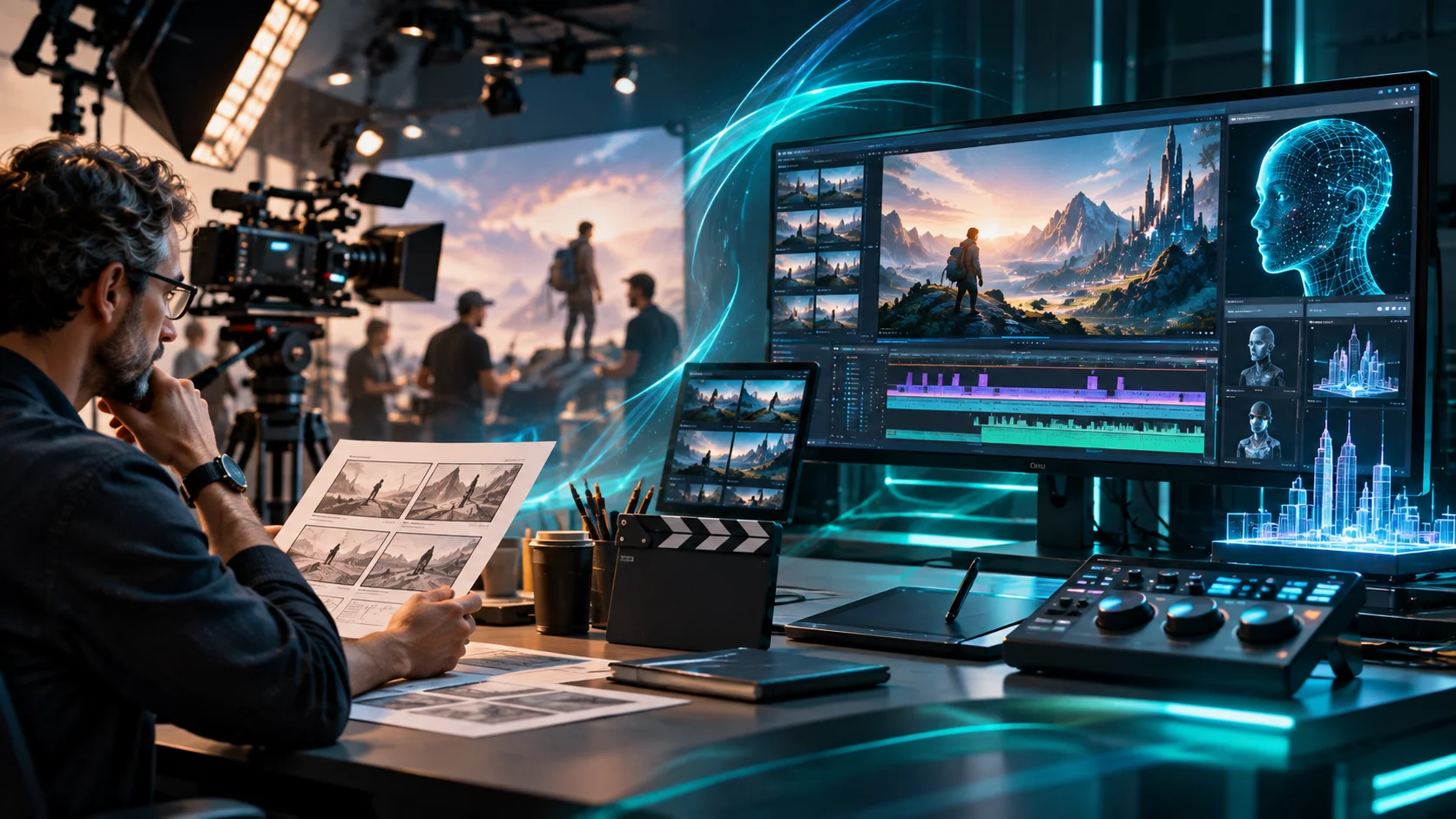
The strongest AI video production workflows combine generative technology with traditional filmmaking principles and human creative judgment.
AI can accelerate specific production tasks, but storytelling, visual consistency, pacing, and brand interpretation still require thoughtful creative decisions.
A professional workflow typically includes five stages.
- 1. Creative consultation and concept development: The process begins with understanding the client’s vision, audience, campaign objectives, and brand identity.
- The creative team develops a concept, identifies the appropriate video format, and determines where AI-generated visuals can add value.
- 2. Scriptwriting and storyboarding: A structured script establishes the message, narrative, and sequence of scenes.
- Storyboards help visualize camera angles, transitions, characters, backgrounds, and important visual details before production begins.
- 3. AI-assisted visual generation: Generative models can create backgrounds, cinematic environments, animated sequences, product settings, and supporting visual assets.
- The production team selects the appropriate model combination based on the creative job rather than relying on one tool for every task.
- 4. Editing and post-production: Generated content is combined with traditional footage, voiceovers, music, sound effects, typography, and motion graphics.
- Professional editing ensures that individual scenes work together as a coherent video.
- 5. Quality control and delivery: The final video is reviewed for visual consistency, audio quality, brand alignment, factual accuracy, and platform specifications.
This combination of AI-powered workflows and human expertise creates a more controlled production process than simply generating disconnected video clips.
What Types of Videos Can an AI Video Production Agency Create?
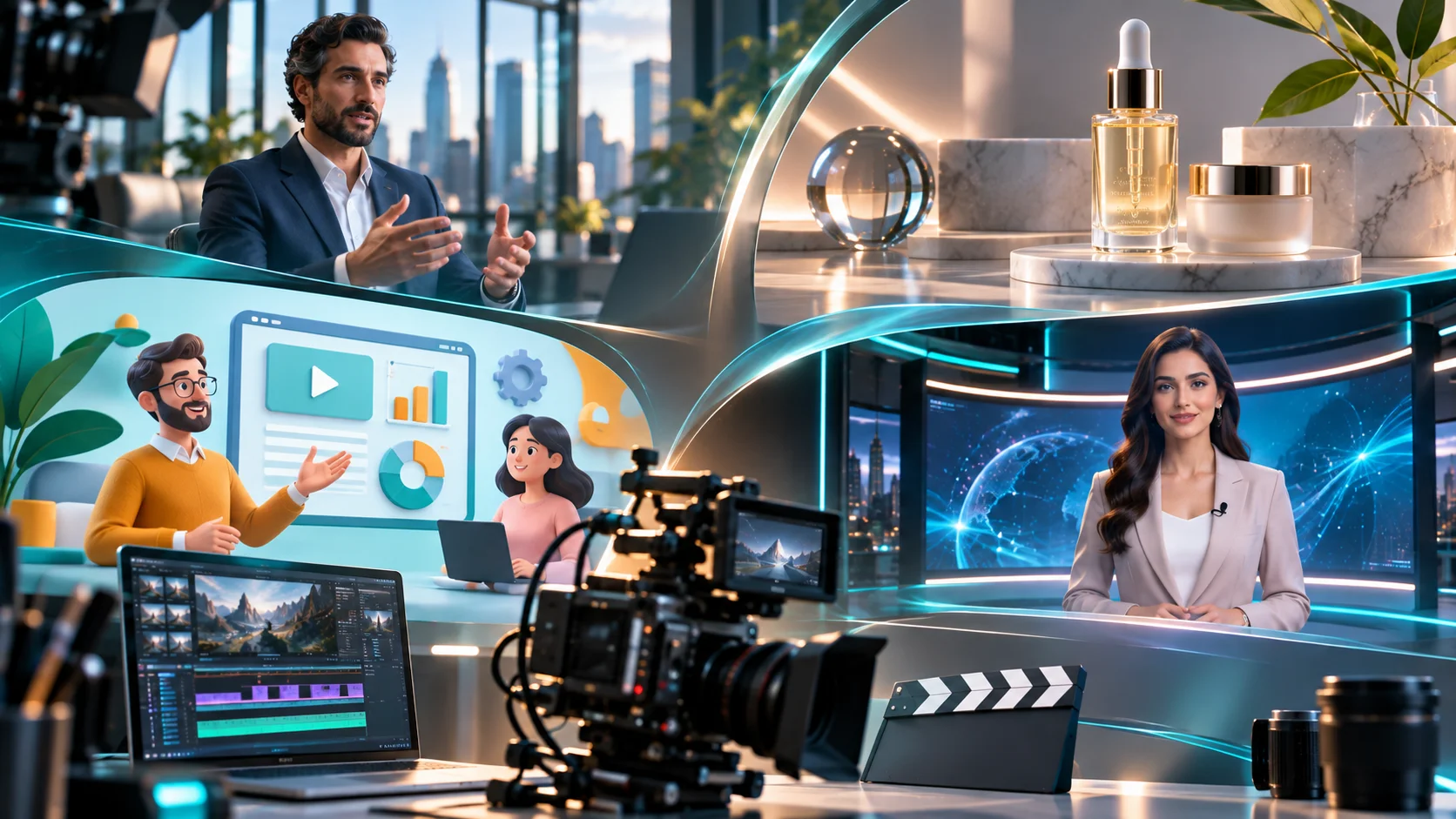
An AI-powered video production company can support different business requirements, from short social media advertisements to detailed corporate presentations.
Common applications include:
Corporate and brand films
Corporate videos communicate a company’s identity, mission, values, expertise, and services. AI-generated environments and cinematic visuals can support brand storytelling without requiring every scene to be filmed traditionally.
Commercial advertisements
AI-assisted commercials allow creative teams to explore different visual concepts, campaign variations, and storytelling approaches for digital advertising.
Explainer videos
Explainer videos simplify complex information through animation, illustrations, characters, and structured narratives.
For example, a software company could use an animated sequence to explain how its platform connects different business processes.
AI avatar-led videos
Digital presenters can deliver product information, onboarding instructions, educational material, and internal communications.
These formats are particularly useful when a business needs consistent presentation across multiple content pieces.
Product demonstrations
AI-generated environments, CGI expertise, and motion graphics can help communicate product features and demonstrate how products work.
Social media videos
Short-form videos can be adapted for Instagram, LinkedIn, YouTube, TikTok, and other digital platforms.
Businesses can develop multiple versions of a central campaign concept while maintaining consistent visual branding.
Educational and training videos
Companies and educational organisations can use animated characters, explainers, and avatar-led content to make information easier to understand.
AI Video Creation vs Traditional Video Production: What Is the Difference?
AI video production and traditional filmmaking serve overlapping purposes, but they use different production methods and have different creative considerations.
The appropriate approach depends on the project’s objectives, visual requirements, available assets, and intended audience.
| Comparison | AI Video Production | Traditional Video Production |
| Visual creation | Uses generative models and digital assets | Uses cameras, locations, sets, and physical production |
| Production process | Can automate or accelerate selected tasks | Requires conventional filming and production stages |
| Creative flexibility | Supports rapid exploration of visual concepts | Provides direct control over physical environments |
| Human involvement | Requires creative direction, editing, and review | Relies heavily on production crews and creative specialists |
| Presenters | Can use AI avatars | Uses real presenters and actors |
| Visual effects | Can generate scenes and synthetic environments | Often uses CGI, practical effects, and compositing |
| Brand consistency | Requires careful visual and editorial controls | Can be managed through production direction and art direction |
| Best applications | Explainers, concept videos, digital campaigns, and selected commercial content | Live-action campaigns, interviews, events, and authentic real-world footage |
Hybrid production is often the most practical approach.
For example, a corporate campaign could combine real footage of employees and facilities with AI-generated environments, animated graphics, and professionally edited sequences.
This approach retains authentic human elements while using generative technology where it provides creative value.
How Do You Choose the Right AI Video Creation Agency?
Choosing an AI video production partner requires evaluating more than its collection of generation tools or software applications.
Businesses should consider the following factors.
1. Creative direction and storytelling
An effective agency understands how to transform a business objective into a compelling narrative.
It should be able to develop scripts, storyboards, visual concepts, and messaging rather than simply generate attractive scenes.
2. Technical production expertise
Look for experience with AI video generation, image generation, animation, CGI, sound design, and professional editing.
Understanding traditional production techniques is also important when projects require a combination of real and generated footage.
3. Brand understanding
Every video should reflect the company’s visual identity, communication style, and positioning.
This includes colours, typography, logo placement, tone of voice, and visual consistency.
4. Platform-specific delivery
A corporate presentation requires a different structure from a vertical social media advertisement.
The agency should understand aspect ratios, video duration, subtitles, file formats, and platform requirements.
5. Communication and consultation
A structured consultation process helps clarify the creative vision, production requirements, approval stages, and expected deliverables.
6. Responsible AI practices
Ask how the agency handles generated assets, voice likenesses, permissions, commercial usage rights, and disclosure requirements.
These considerations are particularly important for enterprise brands and businesses operating in regulated industries.
Quick Facts
- AI video production combines generative technology with human creative direction.
- Common formats include commercials, explainers, corporate films, product demos, and avatar-led content.
- AI can support script development, visual generation, animation, and editing workflows.
- Hybrid production combines authentic footage with AI-generated elements.
- Professional editing remains important for storytelling and visual consistency.
- AI-generated content should be reviewed for factual accuracy, brand suitability, and potential intellectual property concerns.
- Video SEO requires more than uploading a video; discoverability also depends on the webpage, metadata, accessibility, and technical implementation.
Is AI-Generated Video Suitable for Professional Brands?
AI-generated video can be suitable for professional brands when production quality, authenticity, transparency, and brand consistency are properly managed.
However, using artificial intelligence does not automatically make a video professional.
A successful production requires human oversight at every important creative stage.
Consider these essential practices:
- Maintain visual consistency: Characters, products, environments, and brand elements should remain consistent across scenes.
- Protect brand identity: Generated visuals should follow approved brand guidelines.
- Review factual information: Product specifications, service descriptions, and corporate statements must be verified.
- Respect intellectual property: Confirm that source materials, generated assets, music, voices, and other creative elements are appropriate for the intended commercial use.
- Use AI transparently: Disclose realistic synthetic or significantly altered content when required by applicable platform policies or other relevant obligations.
- Protect privacy: Avoid uploading confidential business information or personal data to AI systems without appropriate authorisation and safeguards.
- Include accessibility features: Captions, readable graphics, and clear audio improve the viewing experience for different audiences.
Common Misconceptions About AI Video Production
Several misconceptions can lead businesses to misunderstand what AI-powered video production can achieve.
Misconception 1: AI can replace the entire creative team.
AI can automate selected tasks, but it does not independently understand every brand’s positioning, audience expectations, or communication priorities. Human creative direction remains essential.
Misconception 2: AI-generated videos always look artificial.
Modern generative workflows can create convincing visual sequences. However, results depend on the source material, generation model, creative direction, and post-production.
Misconception 3: Professional video production no longer requires editing.
Editing remains a fundamental part of production. Generated scenes must be reviewed, organised, refined, and integrated into a coherent narrative.
Misconception 4: Every business needs AI-generated video.
Some projects benefit more from interviews, real product demonstrations, customer testimonials, or traditional filming. AI should be selected according to the communication objective.
Misconception 5: AI-generated videos automatically perform well in search engines.
Video visibility depends on content relevance, website quality, technical accessibility, metadata, and other search considerations. AI generation alone does not guarantee visibility.
How Does Video SEO Improve the Discoverability of AI-Generated Content?
Video SEO improves the technical and contextual signals that help search engines discover, understand, and present video content.
Creating a professional video is only one part of an effective digital content strategy. Businesses should also consider how their videos are published and integrated into their websites.
Important optimisation practices include:
- Create descriptive video titles: Use clear titles that explain the subject of each video and naturally incorporate relevant search terms.
- Write informative descriptions: Descriptions should explain what viewers will learn, what the video covers, and how it relates to the business.
- Use video thumbnails: A distinctive thumbnail helps communicate the video’s subject and provides a visual preview.
- Implement VideoObject structured data: Schema.org VideoObject markup can communicate information such as the video’s name, description, thumbnail, upload date, and duration.
- Build dedicated video landing pages: When appropriate, create pages where individual videos are the primary content rather than treating videos as unrelated additions to existing pages.
- Add captions and transcripts: Captions improve accessibility, while transcripts make spoken information available in a readable format.
- Optimise for GEO and AEO: Generative Engine Optimisation and Answer Engine Optimisation benefit from clear explanations, descriptive headings, factual information, and well-structured content.
For example, an explainer video about a software product can be accompanied by a webpage containing a concise product description, relevant FAQs, and a transcript.
This gives search engines and AI-powered answer systems additional context about the content.
How Mednetiks Helps Businesses Create Professional AI Video Content
Mednetiks approaches video production as part of a broader digital communication strategy, combining creative development, content creation, and digital expertise.
The objective is to help businesses communicate their ideas through visual content that supports their brand identity and marketing requirements.
Services can be aligned with different production needs, including:
- AI-assisted video creation: Developing visual concepts and using generative technology to support creative video production.
- Corporate and commercial video content: Creating structured video concepts for companies, professional services, and business campaigns.
- Explainer and educational videos: Transforming complex information into understandable visual narratives through animation, graphics, and storytelling.
- Brand identity integration: Ensuring that video content reflects the company’s established visual language, including colours, typography, and brand positioning.
- Content and media production: Combining video content with supporting digital assets, social media content, and marketing materials.
- Website and SEO integration: Connecting video production with website development and search optimisation to create a more cohesive digital presence.
A More Integrated Approach to Digital Content
Video content works best when it supports a consistent brand experience across digital channels.
A business launching a new service, for example, might need a commercial video, an explainer, social media adaptations, and a dedicated website landing page.
Coordinating these elements helps maintain consistent messaging and visual identity throughout the campaign.
Businesses interested in combining AI-assisted creativity with professional digital production can contact Mednetiks to discuss their objectives and explore a suitable production approach.
Contact Information
- Email: enquires@mednetiks.com
- Telephone: +44 20 8144 5052
- Address: 12–18 Sidcup House, Sidcup, UK
Frequently Asked Questions About AI Video Creation Agencies
1. What is an AI video creation agency?
An AI video creation agency specialises in producing video content using artificial intelligence, generative models, animation, and professional editing. Its services can include commercials, explainers, corporate videos, and AI avatar-led content.
2. How does AI video creation work?
AI video creation typically involves developing a script, preparing visual concepts, generating images or video sequences, editing the material, and completing post-production. Human creative direction helps maintain quality and consistency.
3. Can AI create professional corporate videos?
Yes. AI can support the creation of corporate videos through generated environments, animation, visual effects, and digital presenters. Professional editing and brand oversight remain important.
4. What is the difference between AI-generated videos and traditional video production?
AI-generated videos use generative models to create or modify visual content, whereas traditional production relies primarily on cameras, actors, physical locations, and conventional filming techniques. Hybrid production combines both methods.
5. What types of businesses benefit from AI video production?
Businesses in technology, education, retail, healthcare, professional services, manufacturing, and other industries can use AI-assisted video content for advertising, product demonstrations, training, and corporate communication.
6. Can AI create explainer videos and commercials?
Yes. AI tools can support animated explainers, commercial concepts, product demonstrations, and branded advertisements. The final quality depends on creative planning, visual direction, and editing.
7. Is AI video production suitable for social media marketing?
Yes. AI-assisted production can support short-form content for platforms such as Instagram, LinkedIn, YouTube, and TikTok. Videos should be adapted to each platform’s audience, format, and communication requirements.
8. How do I choose the right AI video production company?
Evaluate the company’s creative capabilities, production experience, editing expertise, brand understanding, communication process, and approach to responsible AI use. Review whether its workflow can support your specific business objectives.